Ian O’ConnorCentrale Lyon · INL

Research

Moore’s law is slowing, and the search is on for devices and architectures that can replace or complement the CMOS transistor at the heart of data processing. My work, as joint head of the Electronics group at INL, explores what advanced, emerging and alternative devices can contribute, and develops the design methods needed to evaluate them at system level.

Energy-efficient edge computing with emerging devices
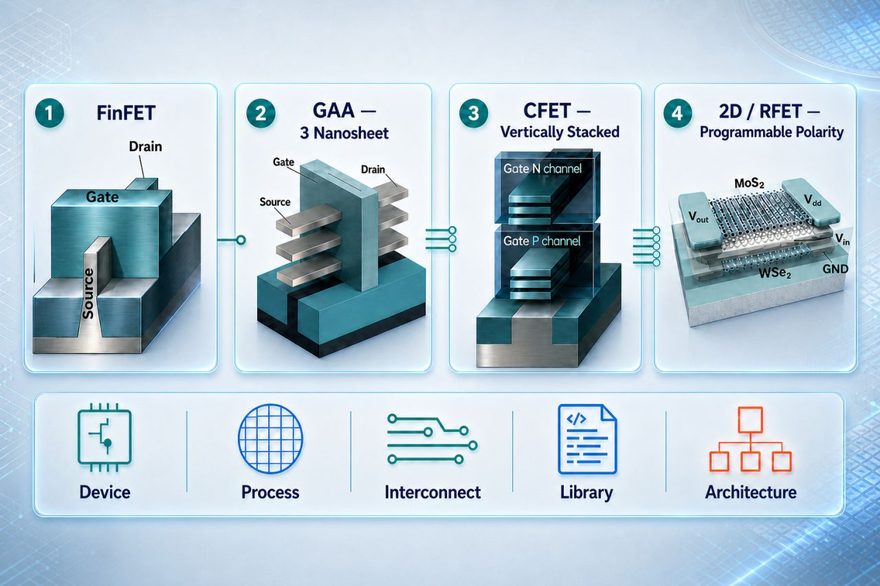
Illustration: device roadmap from FinFET to 2D and reconfigurable FETs
From The Co-Optimized Silicon Stack

Edge computing must deliver low-latency, secure processing as close as possible to the sensor, usually on a very limited energy budget. Reconfigurable and in-memory hardware accelerators placed in the acquisition or processing chain can reduce the load on the central core, and emerging devices offer new building blocks to make them far more efficient. They also invite us to revisit computing paradigms such as approximate, stochastic and neuromorphic computing.

Earlier work exploited the extra terminal of double-gate devices for reconfigurability. Current work focuses on 3D logic with vertical nanowire FETs, which favor regular structures such as majority or pass-gate logic, and on HfO₂-based ferroelectric capacitors and FeFETs. These CMOS-compatible, fast, low-power non-volatile devices enable fine-grain logic-in-memory, “normally-off” computing and new energy-efficient computing paradigms.

Highlights

  • Ultra-fine-grain reconfigurable cells and architectures on ambipolar double-gate CNTFETs and DG-MOSFETs, with patented interconnect topologies and dedicated logic synthesis and mapping flows
  • 3D logic circuits and a 3D neural-network compute cube on vertical nanowire FETs
  • FeFET and FeMFET memories, logic-in-memory and in-memory accelerators for edge AI
  • Reconfigurable FETs and 2D van der Waals ferroelectric devices for AI electronics

10 PhD theses and 4 postdocs. Projects: Nanosys, Multigrilles, Nanograin, Grilles-CMOS, LEGO, 3eFerro, FVLLMONTI, Ferro4EdgeAI, FerroFutures, MultiSPIN. Partners include CEA-LETI/LIST/IRAMIS, IMS, IM2NP, LIRMM, IEMN, LAAS, NaMLab, EPFL, Global TCAD Solutions, Polytechnique Montréal and the University of Notre Dame.

Selected publications

  • Van der Waals Inverted-Floating-Gate Transistors for Artificial Intelligence Electronics
    M. Soliman, C. Marchand, A. Mahmoudi, N. Kumar Rajak, T. Taniguchi, K. Watanabe, A. Gloppe, B. Doudin, D. Deleruyelle, I. O’Connor, A. Ouerghi, J.F. Dayen
    ACS Nano, 19(19), 2025 · doi
  • 3D Logic circuit design oriented electrothermal modeling of vertical junctionless nanowire FETs
    S. Mannaa, A. Poittevin, C. Marchand, D. Deleruyelle, B. Deveautour, A. Bosio, I. O’Connor, et al.
    IEEE J. Exploratory Solid-State Computational Devices and Circuits, vol. 9, no. 2, 2023 · doi
  • A FeFET-based hybrid memory accessible by content and by address
    C. Marchand, I. O’Connor, M. Cantan, S. Slesazeck, T. Mikolajick
    IEEE J. Exploratory Solid-State Computational Devices and Circuits, vol. 8, no. 1, 2022 · doi
  • CNTFET Modeling and Reconfigurable Logic Circuit Design
    I. O’Connor, J. Liu, F. Gaffiot, F. Prégaldiny, C. Lallement, C. Maneux, et al.
    IEEE Trans. Circuits and Systems I, vol. 54, no. 11, 2007 · doi
  • VNWFET
  • FeFET / FeMFET
  • RFET
  • Logic-in-memory
  • Edge AI

Silicon photonics for high-performance and in-network computing

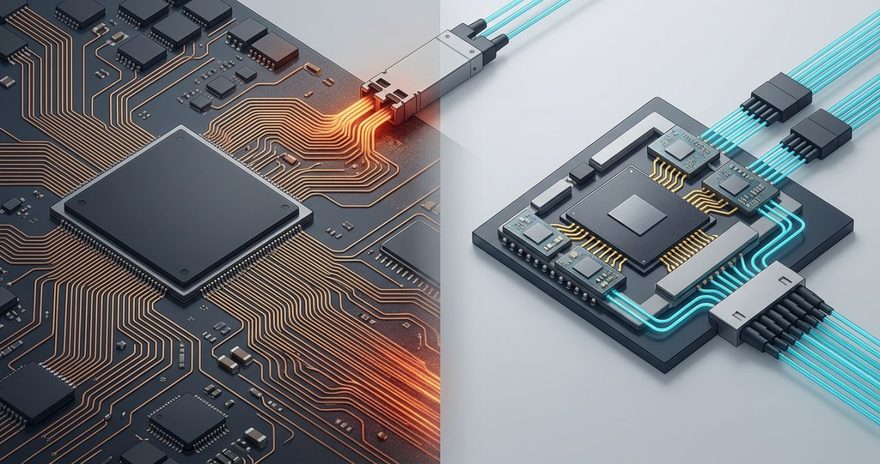
Illustration: electronic chip next to a co-packaged optical engine
From The Co-Optimized Silicon Stack

Distributed manycore architectures, now driven by AI workloads, need organized high-speed communication between processors with aggregate data rates beyond 100 TB/s. Metallic interconnect is highly inefficient in this role, at around 1 pJ/bit/mm. On-chip optical data transport is a potential solution, and this research assesses where and how it pays off.

Current work targets energy-efficient, broadcast-aware nanophotonic interconnect below 0.1 pJ/bit for an aggregate 100 TB/s, and photonic computing: matrix multiplication combining stochastic computing with phase-change materials on silicon photonics, reservoir computing, and photonic convolutional neural networks on lithium niobate on insulator.

Highlights

  • Among the first predictive assessments of optical interconnect performance per technology node
  • Passive and active optical network-on-chip topologies exploiting wavelength, and system-level models integrated with an industrial communication protocol
  • Thermal-aware laser control and wavelength allocation for energy-efficient nanophotonic interconnects
  • Photonic GEMM with phase-change materials and stochastic computing; photonic reservoir computing and CNNs

14 PhD theses and 5 postdocs. Projects: Heteropt, PICMOS, WADIMOS, HELIOS, OpticALL2, Octane, Neuropuls, REDI, PEPR IA Adapting, CAMELIA LEAF and CHALICE. Partners include CEA-LETI, INRIA-IRISA, C2N, Kalray, IMEC, STMicroelectronics, Polytechnique Montréal, Concordia University, HKUST and RMIT.

Selected publications

  • Reconfigurable Photonic GEMM Based on Phase-Change-Materials and Stochastic Computing
    R. Cardoso, C. Zrounba, M. Abdalla, M. Gomes de Queiroz, P. Jimenez, I. O’Connor, S. Le Beux
    IEEE/Optica J. Lightwave Technology, 2024 · doi
  • Minimum complexity integrated photonic architecture for delay-based reservoir computing
    M. Abdalla, C. Zrounba, R. Cardoso, P. Jimenez, G. Ren, A. Boes, A. Mitchell, A. Bosio, I. O’Connor, F. Pavanello
    Optics Express, 31(7), 2023 · doi
  • Towards maximum energy efficiency in nanophotonic interconnects with thermal-aware on-chip laser tuning
    H. Li, A. Fourmigue, S. Le Beux, I. O’Connor, G. Nicolescu
    IEEE Trans. Emerging Topics in Computing, vol. 6, no. 3, 2018 · doi
  • Systematic Simulation-Based Predictive Synthesis of Integrated Optical Interconnect
    I. O’Connor, F. Tissafi-Drissi, F. Gaffiot, J. Dambre, M. De Wilde, D. Stroobandt, J. Van Campenhout, D. Van Thourhout
    IEEE Trans. VLSI Systems, vol. 15, no. 8, 2007
  • Optical NoC
  • PCM photonics
  • LNOI
  • Photonic neural networks

Design–technology co-optimization for heterogeneous integrated systems

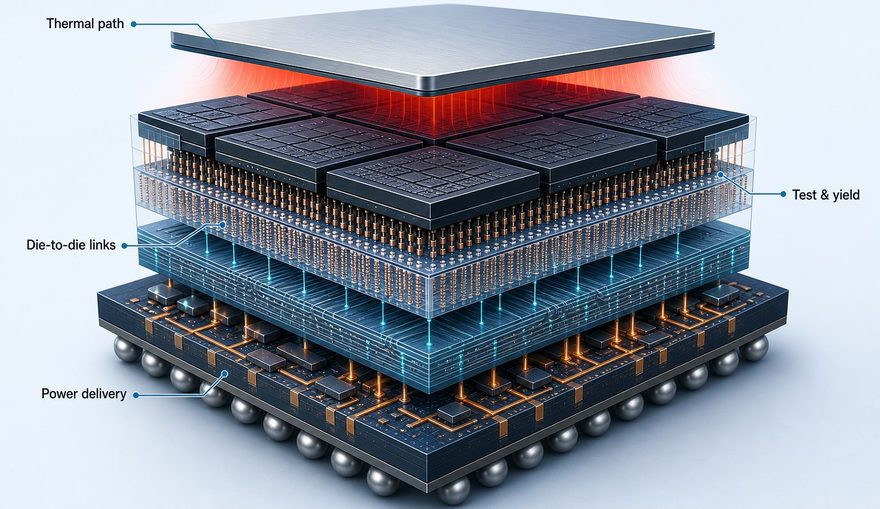
Illustration: 3D chiplet stack with thermal path, die-to-die links and power delivery
From The Co-Optimized Silicon Stack

“More-than-Moore” integration brings power management, sensing, actuation and biosensing from the board into the package or onto the chip, and 2.5D and monolithic 3D technologies multiply the opportunities. Design technology has not kept pace: partitioning, multi-physics simulation and co-design of heterogeneous parts remain open problems. The challenge is like searching for the center of a vast three-dimensional maze with a flashlight and no map.

This work develops ways to predictively extract and exploit system and circuit design information across physical domains, and applies them to multi-physics sensor hubs, 3D ICs and, now, system–technology co-optimization of chiplet-based and near-memory computing architectures.

Highlights

  • Meta-optimization for early, deterministic floorplanning of 3D ICs, accounting for interconnect resources, traffic, thermal variation and cost
  • Patented predictive synthesis of multi-physics systems by hierarchical approximation and combination of sub-system Pareto fronts
  • Bounds on analog performance variability by combining design of experiments with the Cornish–Fisher expansion
  • DTCO/STCO methodologies for emerging memories and near-memory computing

Projects under my coordination include Osmose, Auto-BAW, 3D-IDEAS, HELICITY, CHOOSE and PHOENIX, as well as the Eureka CATRENE projects 3DIM3 and H-Inception. Partners include CEA-LETI/LIST, STMicroelectronics, iCube, IMEP-LAHC, TIMA, TU Delft, Fraunhofer and Polytechnique Montréal.

Selected publications

  • Frequency Design of Lossless Passive Electronic Filters: a state-space formulation of the direct synthesis approach
    A. Perodou, A. Korniienko, G. Scorletti, M. Zarudniev, J.B. David, I. O’Connor
    IEEE Trans. Circuits and Systems I, vol. 68, no. 1, 2021 · doi
  • Analog IC variability bound estimation using the Cornish-Fisher expansion
    H. Filiol, I. O’Connor, D. Morche
    IEEE Trans. Computer-Aided Design of Integrated Circuits and Systems, vol. 31, no. 9, 2012
  • 3D IC floorplanning: automating optimization settings and exploring new thermal-aware management techniques
    F. Frantz, L. Labrak, I. O’Connor
    Microelectronics Journal, vol. 43, no. 6, 2012
  • Multi-physics Optimization Through Abstraction and Refinement
    L. Labrak, I. O’Connor
    in Design Technology for Heterogeneous Embedded Systems, Springer, 2012
  • DTCO / STCO
  • 3D integration
  • Chiplets
  • Multi-physics synthesis